Newton's inertia
Newton’s first law says an object remains at rest or continues moving at constant velocity unless acted on by a net external force. Inertia is the tendency of matter to resist changes in motion.
How it works
Mass measures inertia in classical mechanics: a larger mass requires a larger net force for the same acceleration. The law applies in inertial reference frames, which are not accelerating or rotating in the relevant sense.
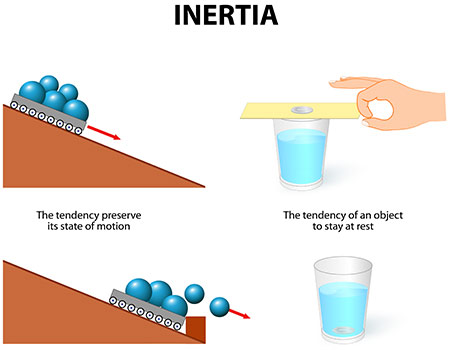
Example or application
A book stays on a table until a force moves it. A rolling object slows because friction and air resistance act on it; without a net force, its velocity would remain constant.
Scope and limits
The law does not say motion always needs a continuing force. It also does not make friction disappear; real situations include forces that change motion.
Explore the parent hub: Physics, Space and Earth Science
