What is the advantage of using exponential notation
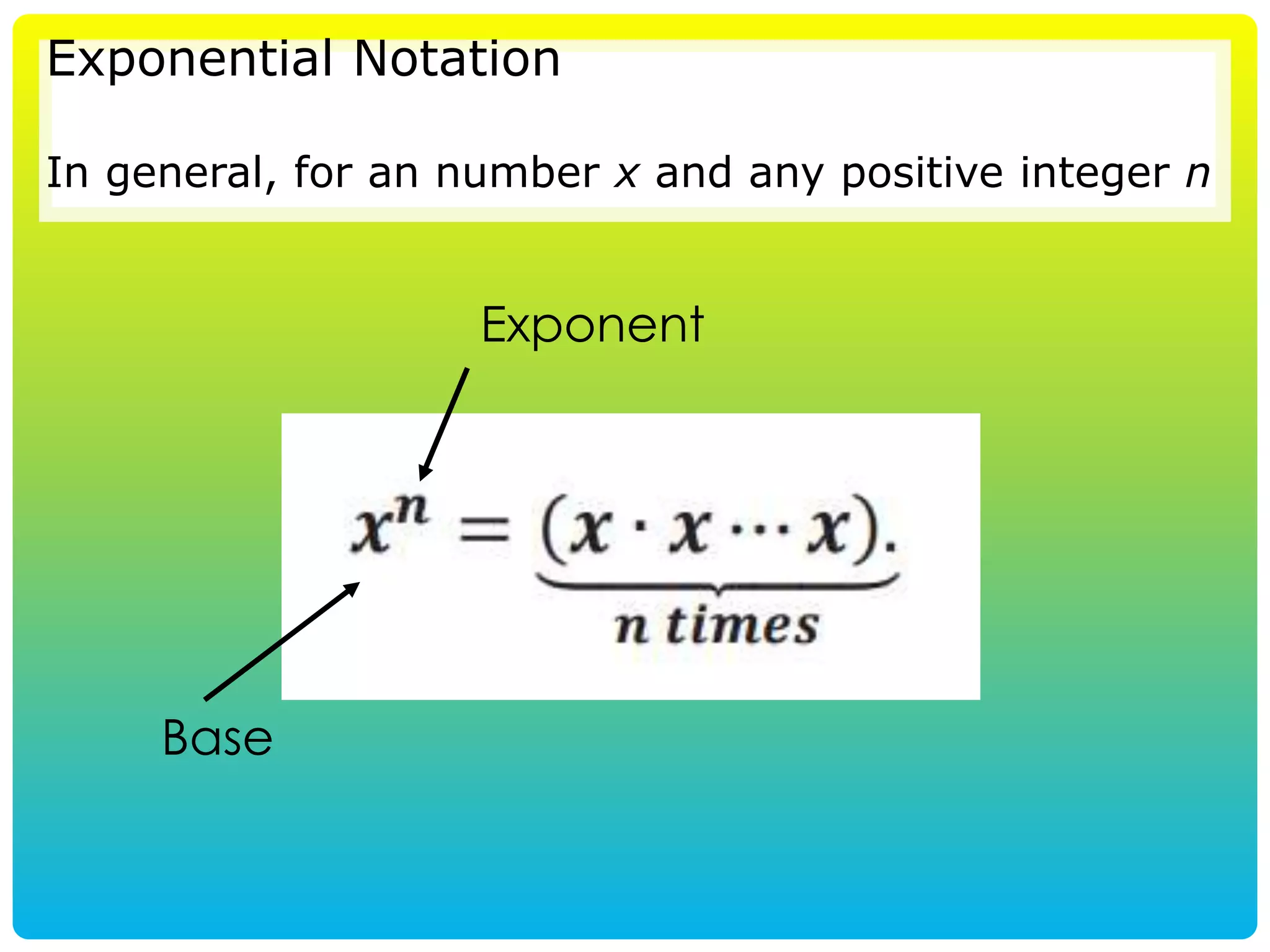
Exponential notation represents repeated multiplication compactly. Scientific notation uses a coefficient multiplied by a power of ten, making very large or small quantities easier to write, compare, and calculate with.
Meaning and context
For example, 3,200,000 can be written as 3.2 × 10⁶. The value 0.00045 can be written as 4.5 × 10⁻⁴. The exponent tracks the scale while the coefficient communicates the significant digits being displayed.
Examples and usage
Multiplying 2 × 10³ by 4 × 10⁵ gives 8 × 10⁸: multiply the coefficients and add the exponents. This is often easier to follow than counting zeros in long ordinary-number expressions.
What to check
A compact form is not automatically more precise. Precision depends on the measurement and significant figures, not only the notation. Keep negative exponents distinct from negative values: 10⁻³ is a small positive number, while −10³ is negative one thousand.
Explore more: Math and Measurement
