Math discoveries associated with pythagorous
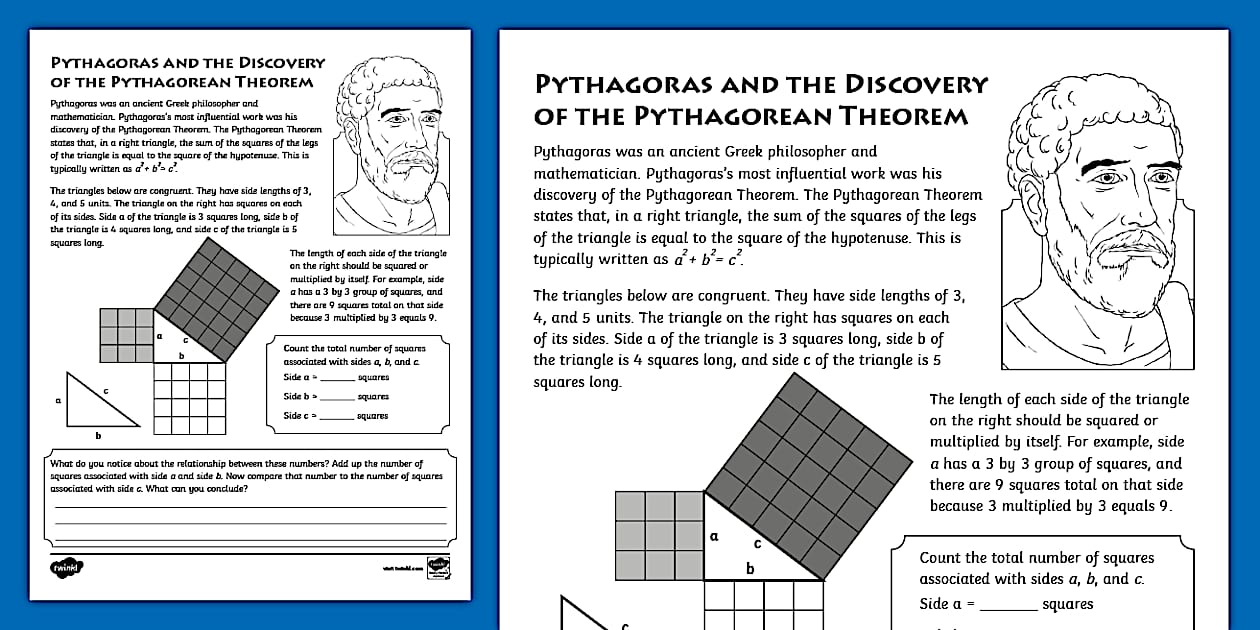
The Pythagorean theorem relates the side lengths of a right triangle: a² + b² = c², where c is the hypotenuse. Its traditional name is associated with Pythagoras, but the history of the relationship extends beyond a simple one-person discovery story.
Meaning and context
The hypotenuse lies opposite the right angle and is the triangle’s longest side. The equation concerns squares of side lengths. It does not say that the two shorter lengths add directly to the longer one.
Examples and usage
For legs of 5 and 12, the squares are 25 and 144. Their sum is 169, so the hypotenuse is 13. For a non-right triangle, this exact relationship does not generally apply.
What to check
Distinguish the mathematical statement from claims about who first knew, proved, or recorded it. Different historical questions require different evidence. In a calculation, identify the right angle and label the hypotenuse before substituting values.
Explore more: Math and Measurement
