Chemistry unbalanced equations
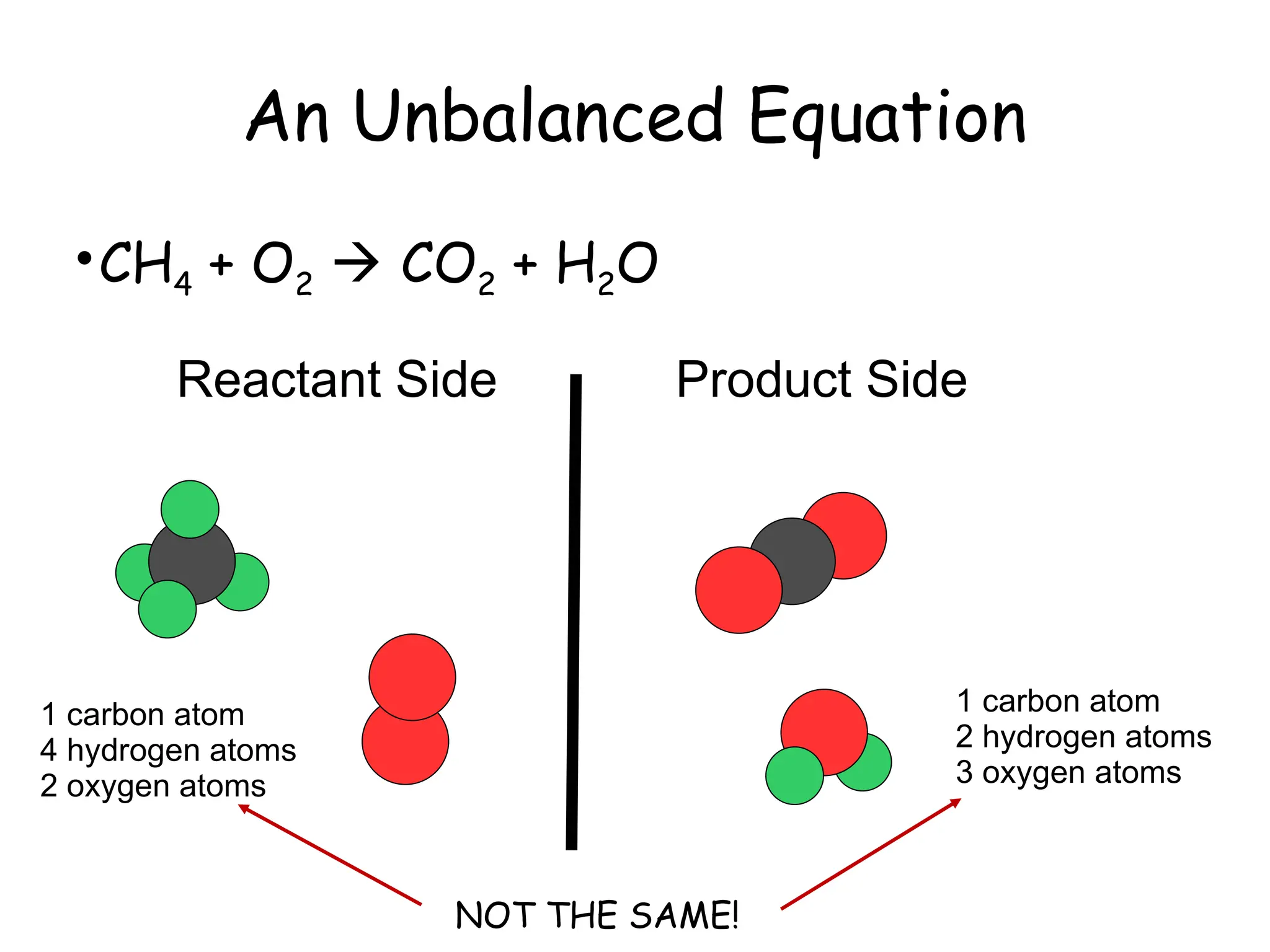
Balancing a chemical equation adjusts coefficients so that each element has the same atom count on both sides. It preserves the chemical formulas of the substances. Changing a subscript would describe a different substance rather than balance the original equation.
Meaning and context
Start by listing each element and counting its atoms. Add coefficients, recount, and reduce to the smallest whole-number ratio when that convention is requested. For ionic equations, charge must also be balanced.
Examples and usage
For H₂ + O₂ → H₂O, use 2H₂ + O₂ → 2H₂O. Each side then has four hydrogen atoms and two oxygen atoms. The coefficients multiply the entire formulas that follow them.
What to check
A balanced equation does not prove that a reaction occurs readily or describe a safe procedure. States, conditions, and reaction feasibility are separate questions. Check the original formulas before balancing so that an incorrect starting equation is not merely made numerically tidy.
Explore more: Chemistry and Elements
